Pages

Tampilkan postingan dengan label WW2. Tampilkan semua postingan

Selasa, 08 April 2014

it started with one rivet, and ended up costing 1 million British pounds


A joke 40th birthday present led to Martin Phillips setting out to achieve his boyhood dream.

Martin had talked about restoring a Spitfire fighter aircraft for so many years that his friends finally clubbed together to buy him his first piece.

But it wasn't a propeller, wing or engine which set the £2.5m project rolling. It was a tiny "pop rivet" — suspended on a string in a huge cardboard box.

Now, some 13 years later, the 53-year-old businessman from Exeter has not only completed the mission of rebuilding the heroic Battle of Britain fighter plane but also realised his dream of seeing the Second World War aircraft take to the sky once more.


Mr Phillips spent years of his life meticulously restoring the iconic fighter plane to its former glory in his Langford warehouse, outside his home in Newton St Cyres, near Exeter.

He has travelled the world in a desperate search for spare parts, expert knowledge and inspiration – although one of its wings comes from a Spitfire which crashed near Exeter Airport and lay for decades in a hedge near a pub until it was salvaged. Mr. Phillips sourced the main fuselage from a scrapyard in South Africa,

http://www.exeterexpressandecho.co.uk/Martin-s-Spitfire-returns-sky/story-18013935-detail/story.html


photos from http://www.dailymail.co.uk/news/article-2270031/Businessman-spent-1m-restoring-Spitfire-scrapyard-10-years-ago-sees-fly-again.html

Senin, 31 Maret 2014

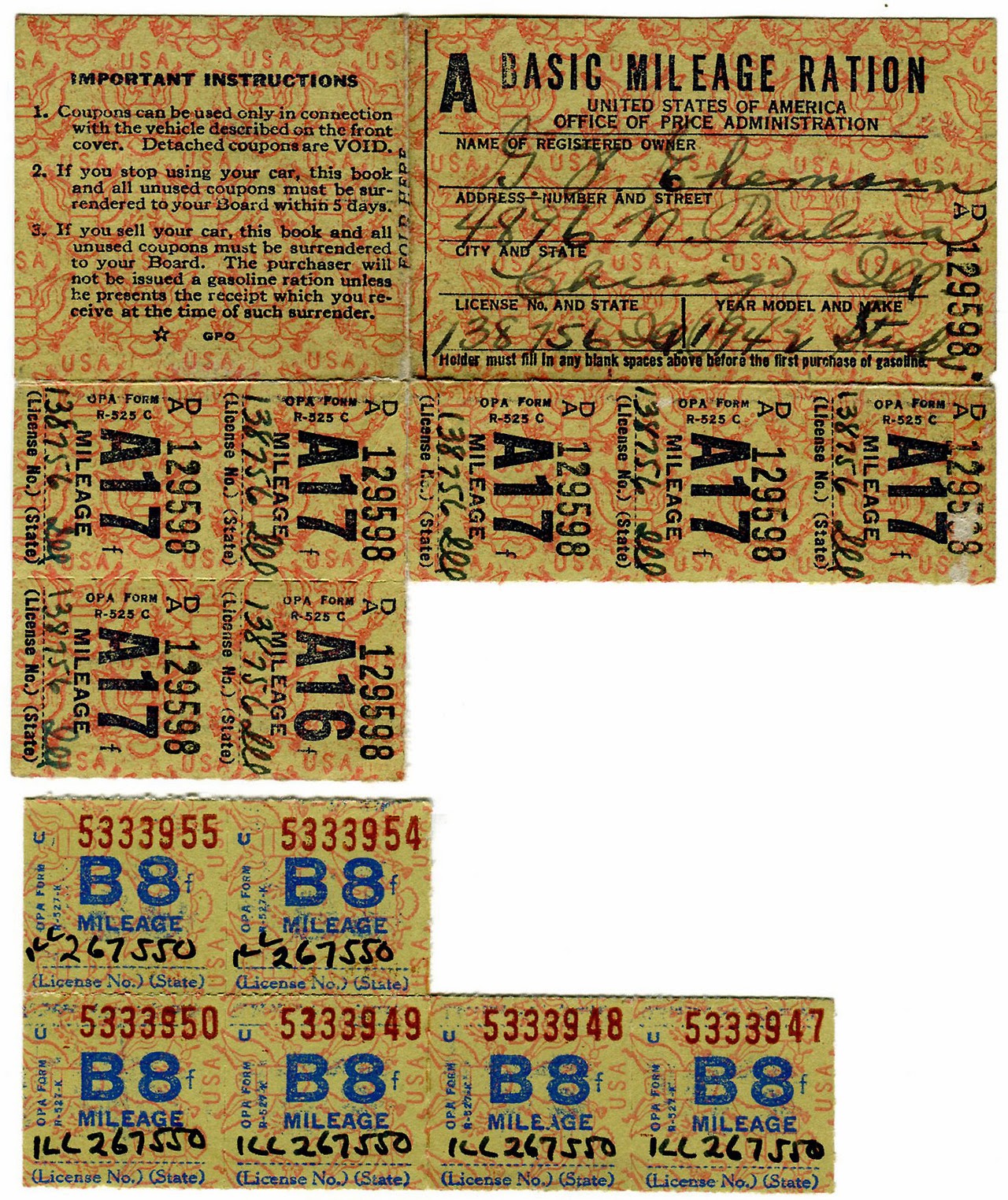
WW2 mileage ration sticker and info


you received stamps and other various paperwork that had to be filled out in order to get your fuel. An “A” sticker was issued to the general public. The “B” my was if your job was considered vital to the war effort. This meant you would be allotted up to eight gallons a week.

There were six different window stickers and even a “R” one for farm vehicles. These were a part of everyday life. So much so they became part of popular culture, like at the end of this classic Bugs Bunny when his crashing plane doesn’t crash because it runs out of gas. Why, because he only had an “A” sticker.

 An interesting yet lesser known fact is that the rationing wasn’t really created to control fuel consumption, but was there to help save on tires. Gasoline could be made domestically, but rubber trees don’t grow here (at least not in mass quantity). That raw material came from Asia, which of course was controlled by Japan at the time. That’s why if you look closely at the paperwork you’ll see a lot of references to mileage and tire inspections. There was even a national speed limit of 35 MPH put in place to help curb tire wear.

 Found on http://familyephemera.tumblr.com/post/73744494852/rationing-was-a-way-of-life-during-wwii-from

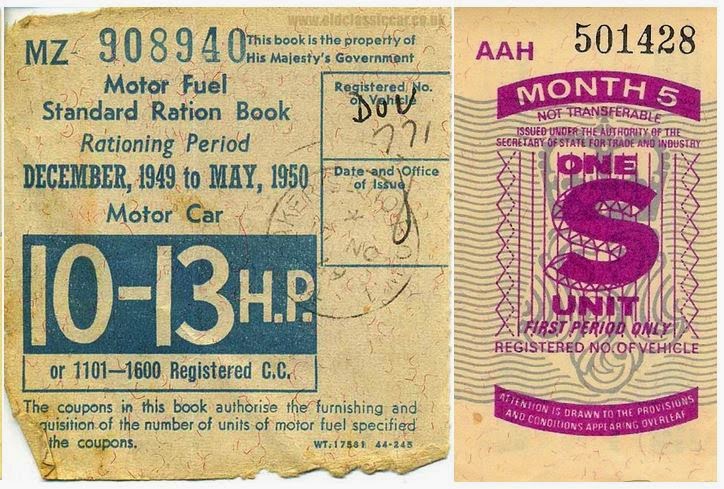
I didn't realize that Petrolicious was also posting about the rationing, but they focused on Canadian and European


found on
http://www.petrolicious.com/wwii-era-gas-ration-coupons-remind-us-how-lucky-we-are

my friend Tris has her parents WW2 ration book, and let me take photos of it:


WW2 Stewart - Warner awards banquet invitation

Jumat, 21 Maret 2014

there is only 1 working Tiger 131 tank that is operable still existing, and a movie "Fury" (not released yet, with Brad Pitt) got it on loan


photo from http://www.dailymail.co.uk/news/article-2123736/Back-70-years-mighty-Tiger-tank-Only-surviving-example-works-restored-wartime-specification.html

it was captured by the smallest margin of luck, a shell from a British Churchill tank damaged the turret just enough to keep if from turning, making the tank useless... and so it was captured, from the African campaign of WW2, and sent to England so any weaknesses could be found and exploited by the Allies.

It was named Tiger by Ferdinand Porsche, and was exceptionally deadly, one Tiger took out a record 22 opposition tanks in one battle in Russia, and one tank commander had a total of 168 enemy tanks destroyed

It's home is the Bovington tank museum in Dorset England.

The movie can be learned about on IMDB http://www.imdb.com/title/tt2713180/?ref_=nm_flmg_act_1

Senin, 17 Maret 2014

Coolest thing of the day, WW2 beer run, kegs strapped to Spitfire wings, chilled to perfection, then delivered to the troops


An English brewery donates a sizable amount of fresh beer for the troops fighting in Normandy and a unique delivery method is created, strapping kegs to the underwings of Spitfires being shipped to forward airfields. Flying at 12,000 feet chills the brew to perfection. The troops love it, but the British Ministry of Revenue and Excise steps in and informs the brewer that it is in violation of law to export beer without paying taxes on it. End of “authorized” beer runs. June 13, 1944.

G-d Da-- bureaucrats.  Found on http://volksrat23.blogspot.co.uk/2013/09/booze-run.html

a B 29 is nearing the end of it's restoration, in Wichita Kansas. Named "Doc" for one of Snow Whites dwarves, it was found in the Mojave where it had been baking for 40 years


Jeff Turner, chairman of the non­profit group Doc's Friends, said the goal of flying Doc to Oshkosh in 2014 is in sight, but as much as $2 million more needs to be raised to make it happen. The Doc project has been in Wichita since 2000, but only this year was it turned over to the new 501(c)(3) nonprofit foundation. That lengthy gestation may be attributed to the stewardship of project organizer and founder Tony Mazzolini, who wanted to ensure any foundation taking on Doc had the right vision. "I needed to make sure I put the aircraft into the right hands for the future,'' Mazzolini explained. When refurbished, Doc will be only the second flyable B-29 in the world.
It will take an estimated $7 million to $9 million to finish the restoration, get the plane flying and secure a hangar, Turner said. “None of us are professional fundraisers,” Turner said. “We’re looking for people who want to step up.”
As the Air Capital of the World, Wichita has the aviation expertise to see the project through, officials said. “The aviation infrastructure here is very good,” Sarver said. “There’s a lot of talented people with the skills we need.” Still, the project needs volunteers with specific skills, such as aircraft electricians, sheet metal mechanics, another inspector and those with radial engine experience.
From : http://www.kansas.com/2014/01/01/3206432/hopes-high-that-restored-b-29.html


for more: http://www.b-29doc.com/


Margaret Bourke White was sent to cover the 8th Bomber Command in WW2, here are a couple of her photos

sunk just shy of arriving where the Allied Forces needed her cargo of bikes, trucks, and trains, the SS Thistlegorm is a diving wonder in the Red Sea

B 24 being restored in Australia for 19 years is now taking longer to restore than it's hanger building will last, and needs a new hanger to finish restoration


Full story at http://www.warbirdsnews.com/warbirds-news/b-24-liberator-restoration-australia-home.html

Quirky fact, it was being used as a chicken coop in Moe Victoria in 1995 when found 

Relics of WW2 at Popondetta ( New Guinea ) airport, are a B-25 Mitchell bomber and a P-47 Thunderbolt fighter.

the Lonesome Polecat, was raised from a Swiss lake in 1952, put on display, and scraped in the 1970's because it hindered a building development


The plane sank largely intact to the bottom of the lake, where it stayed until 1952, when it was raised, restored and exhibited around the country. In 1966, it travelled to St Gallen, where a businessman planned to build a “bomber theme park”.

 This never materialised, so in 1970 the plane went on display in St Moritz. But after a few years it was blocking a building development; since no buyer could be found, it was turned into scrap metal despite being of historical value.

http://www.warhistoryonline.com/war-articles/warbirds-crashed-switzerland-wwii.html

things I just learned about car makers during WW2, and what they made instead of their normal vehicles

Military trucks and ambulances were built by Dodge, Chrysler, the PT Boat and aircraft engines produced exclusively by Packard, including the V-1650 engine which powered the amazing P-51 Mustang fighter. Studebaker built the US6 truck, the M29 Weasel cargo and other crew carriers, the Journal Standard reports.

Many of the tank retrieval trailers and tank recovery vehicles came from the well known taxi cab factory, Checker. Hudson joined the efforts with its aircraft guns, engines, parts and the “Hudson Invader” engine, known having been used to power landing watercraft on D-Day at Normandy, June 6, 1944.

Many of the military appliances and other specific supplies were assembled by Nash-Kelvinator, while Henry Kaiser became a legend thanks to his California shipyard, where he built the “Liberty” and “Victory” cargo ships in very little time.

From http://www.warhistoryonline.com/war-articles/car-manufacturers-world-war-ii-military-might.html

Minggu, 16 Maret 2014

WW2 motorcycle found buried or sunken out in the woods


found on http://www.autoevolution.com/news/a-wwii-treasure-buried-in-the-forest-photo-gallery-66922.html  which has no information. They guess at the type, but know nothing, and don't link to the source, do you know what the story is, can you tell me so I can share it?

Jumat, 14 Maret 2014

Duesenburgs modified to be trucks (trucks weren't very common, inexpenisve, and got better gas rationing than cars during wars)


The top photo dating from 1924, which depicts a Duesenberg Model A that was presumably converted into a shop truck, as opposed to being built as a truck from the outset. With its bed railings, it resembles an early fire rescue truck or a police emergency squad, especially in New York City fashion. This Model A was a service vehicle, owned by the Duesenberg California Company, the local distributorship, located on Sunset Boulevard in Los Angeles. Jon said evidence indicates the auxiliary bodywork was installed by Beverly Auto Body Works, also of Los Angeles. Incidentally, last year at the Amelia Island Concours, one vehicle on the show field was a similar shop truck conversion based on a Rolls-Royce Silver Ghost. "Back then, Duesenberg was probably happy to get any kind of an order it could," Jon explained. "This one may have been shipped out west as a bare chassis, and then finished up at Beverly Auto Body. I'm not sure anybody knows the exact story behind what happened after that," conceding that after its useful life, the Duesenberg California may well have been resold or simply scrapped.

We can tell you a lot more about the "farm truck," if you will, that's depicted in the other image on the facing page. Duesenberg chassis J-350, chassis number 2370, both numbers-matching, rode on the long 153.5-inch wheelbase. It was originally fitted with limousine coachwork, like many of the long-wheelbase Model Js; in this case its body was furnished by Judkins. The car's ownership history from the A-C-D archives shows it then going to a gentleman named Joseph Taylor, who operated Springhill Farms in Mars, Pennsylvania, not far from where the American Austin was assembled in Butler. Taylor's farm specialized in Hereford cattle and Berkshire swine, the latter prized for its rich, marbled meat. It appears that Taylor cut off the Judkins bodywork aft of the chauffeur's seat, and then bolted a simple stake body to the rear chassis. The wheels are non-stock, reduced to 16 inches in diameter.

The exact time frame encompassing this Model J and its life is a little unclear, but the records show that after Taylor was done with it, it passed through four more owners, the last of whom, in Washington State, turned it back into a Full Classic. J-350 was retrofitted with a limousine body by Willoughby that was originally installed on J-237. The Judkins coachwork, or what was left of it, was lost.

"This kind of conversion (of a large luxury car into a truck) was fairly common when gas rationing was taking place. I don't think it was that common with Duesenbergs, though," Jon said. "This is the only one I've ever heard of that I know had this done to it. But you can see that the truck was very purposeful; it was built to work on a farm. It's difficult to skirt the issue about how people would have felt about it in wartime if he was bombing around town in a Duesenberg when everybody else was struggling with ration stamps. It's a fact that many Classics found themselves as derelicts, practically, on used car lots. To the best of our knowledge, there were 481 Model Js built and about 375 survive. Probably, since a Willoughby body went on [this] truck, it still exists."

Found on http://www.hemmings.com/hcc/stories/2013/12/01/hmn_feature21.html

22 sites of WW2 supply airplanes, and 193 MIA remains found by one mountain climber in the Himalayans

a supply route in a very dangerous stretch of the Himalayas took their toll and around 700 airplanes disappeared,

Full story at http://www.warhistoryonline.com/featured-article/rugged-mountains-yield-hundreds-of-wwii-era-plane-crashes-of-lost-hump-airmen.html

So that is news, and good news that some guy went out on his own expense to find and identify some wrecks and human remains, but now for my question... is the US government supposed to take some action if made aware of MIA remains? http://www.warhistoryonline.com/war-articles/pentagon-agency-slow-id-return-remains-americas-fallen.html the answer is yes, and like all functions of the US government, they suck at it, and turn every opportunity into a wasted money boondoggle