Pages

Rabu, 18 Desember 2013

Some Thoughts on Warren Belasco's Americans on the Road: From Autocamp to Motel, 1910-1945

The last few days I have spent some time with Belasco's Americans on the Road, in part because I plan to use this book this time around in a senior seminar this coming spring. I have always found this work, now more than 30 years old, a joy to read. It stimulates my own romantic interest in road trips and travel, although at times the narrative is slow moving and a tad repetitive.  It was a pioneering work in its day, however, and considerable scholarship followed this books 1979 publication. Belasco traces the transition of Americans on the road for leisure. beginning with rough and ready camping during the WWI era to the evolution of free, pay, and cabin type camps during the 1920s and the 1930s. It is a story that brings in much concerning  middle class values and aspirations between the Wars, as the author explores the alternative of the hotel and why Americans desired other ways to travel than by the railroad.
So now that I have taken a decade or so break from reading this book, what struck me the most concerning its contents?
On at least two occasions, Belasco discusses the changing nature of the road trip, as daily distance itineraries increase markedly between the 1920s and the 1930s. The trip no longer is about taking time and seeing the roadside, but getting from place to place, as fast and quickly as possible. So the auto experience becoems far more about speed and driving.

Some passages from page 87:

"There seems to be a certain irresistible impulse within us to keep moving on," wrote one autocamper who was not pleased with the discovery...By the 1920s this mysterious urge to move on assumed the status of conventional wisdom....Yet all too often the auto vacation wound up as a hurried drive to a given objective."

As roads were improved daily average trip distance increased from 250 miles, to 300 miles and finally to 400 miles by the end of the 1930s.

The psychology and culture of driving from an historical perspective certainly could use more study.


Sabtu, 14 Desember 2013

Program and Schedule, Society of Automotive Historians Biennial Conference, Stanford University, April 10-12, 2104

Hi folks -- what follows is the Program for the next SAH Conference, April 10-12, at Stanford University. Many thanks to Arthur Jones, Conference Chair, for a remarkable effort that will bring together academic historians, SAH members, graduate students, international scholars, and those working at the cutting edge of the automobile industry.  I hope to see some of you there!  


Program and Schedule

THURSDAY, APRIL 10, 2014

Board of Directors Meeting
9:00 a.m. – 5:00 p.m. Boardroom

Registration
2:00 – 6:00 p.m.  Hotel Entrance

WELCOME RECEPTION
6:30 - 8:00 p.m.  Stratton Room and Patio
Greetings:  Reilly Brennan, Executive Director Revs Program at Stanford University

FRIDAY, APRIL 11, 2014

Continental Breakfast
7:30 – 8:30 a.m. – Lobby

8:30 - Shuttle bus to Automotive Innovation Facility on Stanford campus

MORNING SESSIONS
Chair:  Arthur W. Jones

9:00 – 9:30 a.m.
“A Portuguese Hybrid Car from the early 20th Century:  A Case Study in Innovation towards Energy Saving”
Speaker:  José Barros Rodrigues
Engineer and Historian, Portugal

9:30 – 10:00 a.m.
“Making the African Car:  Design, Tinkering, and Politics”
Speaker:  Joshua Grace, Assistant Professor of History, University of South Carolina

10:00 – 10:30 a.m.
“Building a Bricolage of Speed: Dirt Track Racecar Construction, 1920-1960”
Speaker:  Alison Kreitzer
University of Delaware

BREAK - 10:30 – 11:00 a.m.

11:00 – 11:30 a.m.
“On the Road, Auto-mobility in American Culture and Literature”
Speaker:  Christina Ann Mesa, Lecturer in American Studies, Stanford University


11:30 a.m. – 12:00 p.m.
“License to Drive:  A History of the Driver’s License from New York in 1914 to California in 2013”
Speaker:  Eric Karl Roth, Attorney and Legal Historian, Stanford University

12:00 – 12:30 p.m.
“Policing the Automotive Society”
Speaker:  Sarah Seo
Princeton University

LUNCH BUFFET – 12:30 – 2:00 p.m.

AFTERNOON SESSIONS
Chair:  John A. Heitmann

2:00 – 2:30 p.m.
“On Balloon Tires into the Automotive Society:  The Low Pressure Tire and Other Technologies of Heavy Truck Transportation”
Speaker:  Jørgen Burchardt, Senior Researcher National Museum of Science and Technology, Denmark

2:30 – 3:00 p.m.
“Historical Development of Crankcase Engine Oils from the Model A to the Z4”
Speaker:  William Chamberlin
Research Engineer, Lubrizol Corporation

3:00 – 3:30 p.m.
“Innovations in Vehicle Coatings during the First Half of the 20th Century:  Breaking a Bottleneck in Automobile Production”
Speaker:  Gundula Tutt, Conservator-Restorer, Institut für Technologie der Malerei
ABK Stuttgart

BREAK – 3:30 – 4:00 p.m.

4:00 – 4:45 p.m.
“   title  tbd   “
Featured Speaker:  Christian Gerdes
Associate Professor of Engineering
Interim Director, Revs Program at Stanford

5:00 Shuttle bus return to hotel

Evening – Dinner on your own


SATURDAY, APRIL 12, 2014

Continental Breakfast
7:30 – 8:30 a.m. – Lobby

8:30 – Shuttle bus to Automotive Innovation Facility on Stanford campus

MORNING SESSIONS
Chair:  Judith E. Endelman

9:00 – 9:30 a.m.
“Firm Competitiveness and Postwar Economic Integration in Europe:  The Case of Volkswagen in the ECSC and EEC”
Speaker:  Grace Ballor, Department of History University of California, Los Angeles

9:30 – 10:00 a.m.
“Volkswagen’s American Experiments, Then and Now”
Speaker:  John Mohr
Auburn University

10:00 – 10:30 a.m.
“Byers A. Burlingame and the Studebaker Corporation:  Villain or Savior?”
Speaker:  Robert Ebert, Professor Emeritus of Economics, Baldwin-Wallace College

BREAK – 10:30 – 11:00 a.m.

11:00 – 11:30 a.m.
“The Trailer Revolution”
Speaker:  David Burel
Department of History, Auburn University

11:30 a.m. – 12:00 p.m.
“Fuel to Drive:  A History of the Gas Station in the United States”
Speaker:  Usua Amanam
Revs Program at Stanford

12:00 – 12:30 p.m.
“Mexico, the United States and International Auto Theft”
Speakers:  John Heitmann
President, Society of Automotive Historians
Professor of History, University of Dayton
and Rebecca Morales, Independent Historian
former curator, San Diego Automotive Museum

LUNCH BUFFET – 12:30 – 2:00 p.m.


AFTERNOON SESSIONS
Chair:  Arthur W. Jones

2:00 – 2:30 p.m.
“Craft, Styling, Design:  The Evolving Disciplines of Car Design in Great Britain”
Speaker:  Helen Evenden
Royal College of Art, London

2:30 – 3:00 p.m.
“The Molecular Interactions of Cleaning Solutions with Lacquered Vehicles”
Speaker:  Owen Falk
Department of Chemical Engineering
Stanford University

3:00 – 3:30 p.m.
“3D Technology:  Additive Manufacturing and Holographic Imaging Applications”
Speaker:  John Marino
Associate Professor, Business Technology
Kent State University at Trumbull

BREAK – 3:30 – 4:00 p.m.

4:00 – 4:45 p.m.
“My Vision of a Feasible Future of Electric Vehicles and Society”
Featured Speaker:  Masato Inoue
Former Product Chief Designer of Nissan LEAF

5:00 Shuttle bus returns to hotel

CLOSING DINNER
AND KEYNOTE ADDRESS
6:30 p.m. – Stratton Room
“Putting It All Together without a Workshop Manual”
Rudi Volti, Professor Emeritus of Sociology
Pitzer College 

Jumat, 13 Desember 2013

The technological significance of the Mercedes W 201 and W 202 Series, 1983-

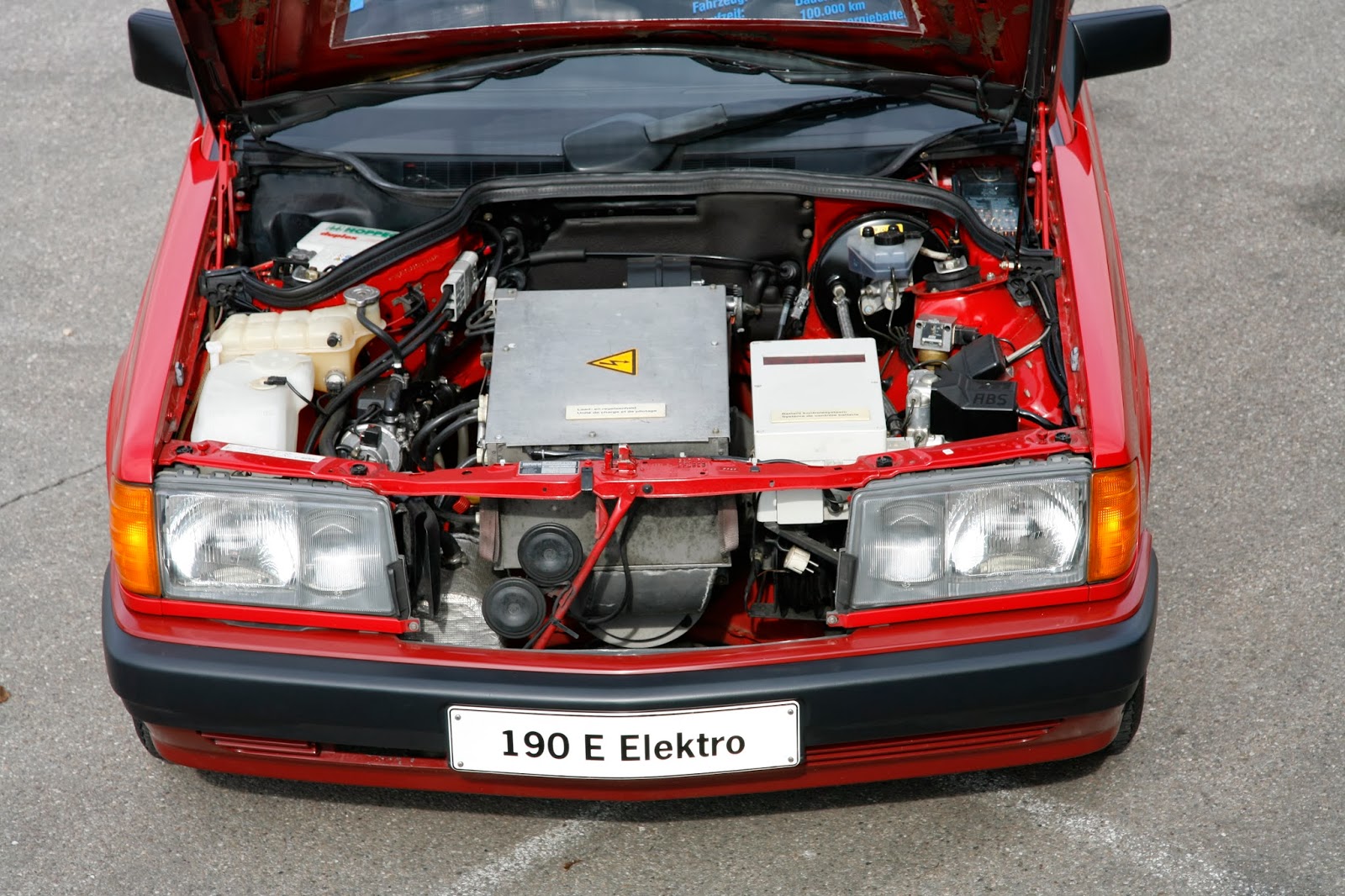
Mercedes-Benz 190 model, experimental vehicle (W 201) with electric drive, 1991


Engine parts of the Mercedes-Benz M 102 E 2.3-16 engine with four-valve technology, 1984


The 201 model series was of key importance for the introduction of new internal combustion engines and the testing of drive configurations – a tradition that all subsequent C-Class model series continued seamlessly. It was not just internal combustion engines that won their place in the history of technology in this way. Alternative drives were also tested in the various model series of the Mercedes-Benz compact class. These systems made the vehicles pioneers in forward-looking mobility.
Modern-era diesel drive systems
One of the main reasons behind the success of model series 201 from 1983 onwards were the then newly developed diesel engines with four (OM 601) or five (OM 602) cylinders. They all had the characteristics of a modern compression-ignition drive system – low fuel consumption, low emissions, lower friction losses, low noise emissions – yet they offered a higher engine output and more torque. The turbocharged variant of the OM 602 also successfully dispelled the image that diesel vehicles were ponderous affairs: it propelled the 190 D 2.5 Turbo launched in 1986 from 0 to 100 km/h in just 11.5 seconds.
Another famous feature was the encapsulation of the diesel engines in the 201 model series to reduce noise emissions. This led to the vehicles being given the nickname “whisper diesel”. This sound-minimising package was a key factor behind the diesel engine’s successful march towards greater acceptance and higher volumes.
Model series 202 was then made ready for a big premiere: at the Frankfurt International Motor Show (IAA) in September 1997, Mercedes-Benz ushered in a new era by introducing the first passenger car diesel engine with common-rail injection. The OM 611 in the C 220 CDI was the first engine to be based on this principle, which revolutionised diesel drive and remains the preferred injection concept for compression-ignition engines to this day. It makes the diesel engine even more economical and can be developed even more exactly to ensure low emissions. The Mercedes-Benz abbreviation “CDI” became synonymous with efficient drive systems. From 2003 onwards, all diesel engines in C-Class model series 203 were based on the common-rail principle.
C-Class model series 204 marked another big premiere at the end of 2008: the OM 651 engine, which combined the latest technology with high output, high torque, low fuel consumption and low emissions. It was even later used in the S-Class, making this the first luxury-class vehicle to feature a four-cylinder engine. The engineers enjoyed installing the OM 651 in a test vehicle – a W 201 model from 1982 – firstly to emphasise its role as a pioneer in diesel technology and secondly to underline the progress made in developing the compression-ignition engine over a period of 25 years.
Powering ahead with petrol engines
“Business as usual” – this motto initially applied to the petrol engines for model series 201. The engines had already featured in other Mercedes-Benz vehicles. The four-valve version of the M 102, which premiered in the 190 E 2.3-16 model in 1983, caused a sensation: not only was it the first series-produced petrol engine with four valves for a Mercedes-Benz passenger car, it also proved a success by being installed in some 19,487 vehicles. This engine became the basis for further production development of four-valve engines that have now long been the technological norm.
In 1995, the Mercedes-Benz designers remembered the legendary supercharged engines with belt-driven supercharger. The renaissance of this technology in passenger cars began with the 2.3-litre four-cylinder engine M 111, which had its production premiere in the C 230 Kompressor at the 1995 Frankfurt International Motor Show. The engine was around a fifth more economical than a similarly powered naturally aspirated engine. This technology allowed high torque with low fuel consumption and low emissions.
At the other end of the power spectrum, the C 43 AMG was unveiled in 1997. It was the first vehicle in the Mercedes-Benz compact class to feature a V8 engine. An output of 225 kW(306 hp) speaks for itself – in the language of AMG, Mercedes-Benz’s performance brand. The C 63 AMG model (204 model series) impressively continued this tradition from 2007 onwards. Its 6.2-litre V8 engine (M 156) remains the largest-displacement and highest-torque engine in a compact-class vehicle to this day.
Electric drive in model series 201 and 202
It was not just internal-combustion engines that continued to set trends in the Mercedes-Benz compact class. Alternative drive systems did too, pointing a way ahead for the automotive industry. A test car based on model series 201 was presented at the Hanover show’s innovation market in 1990 and the Geneva Motor Show in 1991. It featured two permanent magnet excited electric motors fed by sodium/nickel chloride batteries, each of which had an output of 16 kW (22 hp) and was used to drive one rear wheel. One key advantage of this design was the omission of weight-intensive mechanical components. The vehicle paved the way for further developments in electric drive systems.
Between 1992 and 1996, a road test involving 60 passenger cars and vans made by various manufacturers was conducted on the island of Rügen. Several Mercedes-Benz vehicles took part in the four-year test, including 10 passenger cars from the 201 model series with various electric motor/battery combinations. One of these vehicles was used particularly intensively, and clocked up an annual mileage of 100,000 kilometres on the island.
Seven of the electric 190 models weighing around 1,400 kilograms each had a sodium-nickel-chloride high-temperature battery, were used for testing various asynchronous engines and achieved a range of around 110 kilometres. Thanks to the torque characteristics of the drive system, no transmission was required. Three of the test vehicles with synchronous drive system featured nickel-cadmium batteries with a range of around 40 kilometres; these were equipped with a standard manual transmission. All of the vehicles were fitted with two batteries – one at the front and one in the boot – which were connected using heavy-duty cables in view of the peak currents of up to 400 A. The vehicles were charged at special filling stations with solar collectors to ensure systematic testing of the environmental credentials.
An electric vehicle with an asynchronous motor developing 35 kW (48 hp) and a range of around 110 kilometres, based on model series 202, was then exhibited at the 1993 Frankfurt International Motor Show. This vehicle featured powerful ZEBRA high-energy batteries; the acronym stands for “Zero-Emission Battery Research Activities”. One special feature of this vehicle was the innovative positioning of the batteries and powertrain components which. thanks to their size and installation locations, ensured spaciousness on a par with the standard saloon. Also on display at the Frankfurt International Motor Show were two early research vehicles with hybrid drive based on model series 202: one with a parallel hybrid drive, the other with a serial hybrid drive. Both provided key information for the introduction of hybrid technology into production at Mercedes-Benz several years later.
Model series 201 and 202 were therefore technology pioneers used for the early testing of electric and hybrid drive systems in passenger cars. This pioneering spirit lived on in all subsequent Mercedes-Benz vehicles with forward-looking drive systems, whether test vehicles or ultimately production vehicles.

Rabu, 04 Desember 2013

Perhaps a little Range Anxiety? Nissan Leaf Owner Charged with Stealing 5 cents worth of electricity!

There's no such thing as a free lunch, or free electricity. That's the lesson Kaveh Kamooneh, the owner of a Nissan Leaf electric car, is learning after spending 15 hours in jail for plugging his car into a public school's outlet without asking.
Kamooneh was picking his son up from tennis practice at Chamblee Middle School in Chamblee, Ga., when he plugged his Nissan Leaf into a 110-volt external outlet and let it charge "for about 20 minutes," he says. A little more than a week later, cops showed up and arrested Kamooneh, charging him with stealing from the county.
The estimated worth of that stolen electricity? About five cents. But Sergeant Ernesto Ford of the Chamblee Police Department says what Kamooneh was stealing is irrelevant. "A theft is a theft," he told Atlanta's Channel 11 News. Kamooneh plans to fight the criminal charges.

The automobile and the history of America, post-1970 --

This ending quote (p. 473) is from James Flink's seminal article "American Automobile Consciousness" published in the American Quarterly (v.24, October, 1972). It marks the beginning of an extended discussion on this blog.

Automobility has had more important consequences for 20th century American man than even Frederick Jackson Turner's frontier had for our 19th century forebears. Thus the coming of Automobile Consciousness III[ aproximately post-1968/70] marks a significant turning point in American historical development- the end of an era that historians will someday refer to as the age of the automobile. Whether the new era of American historical development that has dawned will be even more an era of the people or become the age of the superstate remains to be seen. Certainly the time has come for concerted, retrospective scholarly inquiry and debate over the details of the American automobile revolution.

So what did happen after 1970 to both America and its automobile industry? Did we gain more freedoms, or have we witnessed the emergence of  a superstate? Did the superstate rise as the automobile industry fell, and are these two phenomena somehow linked? How did we come to accomodate Japanese imports while at the same time not insisting fair trade -- so that American products were not welcome in Japan? With the government bailouts of Chrysler and GM, did the superstate merge with the auto industry?

Senin, 02 Desember 2013

Good- Bye, Paul Walker!

 Paul Walker, the star of the “Fast & Furious” movie series, died Saturday in a car crash that killed one other person outside of Los Angeles. He was 40.


His publicist Ame Van Iden confirmed his death. A statement on Mr. Walker’s Facebook page said he was a passenger in a friend’s car, and that Mr. Walker was in the area to attend a charity event for his organization Reach Out Worldwide.
The Los Angeles County Sheriff’s Department said that speed was a factor in the crash.
Deputies found a Porsche Carrera GT engulfed in flames when they responded to a report of a collision in the community of Valencia, north of Los Angeles. Two people who were found in the car were pronounced dead at the scene.
The Santa Clarita Valley Signal reported that the Porsche crashed into a light pole and tree and burst into flames. The fundraiser, to benefit victims of Typhoon Haiyan, took place at a nearby racecar shop. Attendees rushed to put out the flames with fire extinguishers to no avail.
Mr. Walker’s “Fast & Furious” co-star Vin Diesel posted a photograph of him and Mr. Walker arm-in-arm on Instagram with the message: “Brother I will miss you very much. I am absolutely speechless.”
Mr. Walker rode the “Fast & Furious” franchise to stardom, starring in all but one of the six action blockbusters, beginning with the first film in 2001. The blond-haired, blue-eyed Los Angeles-native brought California surfer good-looks and an easy, warm charm to the series.
The son of a fashion model and a sewer contractor, Mr. Walker grew up in a working class, Mormon household in Glendale, Calif. Mr. Walker’s mother began taking him to auditions as a toddler. He was a child model beginning at the age of 2.
After a string of TV roles as a child in the ’80s, including small roles on “Who’s the Boss” and “Charles in Charge,” Mr. Walker made his feature film debut in the 1998 comedy “Meet the Deedles.” Supporting roles in the films “Pleasantville,” '‘Varsity Blues” and “Flags of Our Fathers” followed.
His performance in the 2000 thriller “The Skulls” caught the eye of producer Neal H. Moritz, who cast him in “The Fast and the Furious” as undercover police officer Brian O’Conner. Adapted from a Vibe magazine article about underground street races, the film became an unexpected hit.
In the sequel, “2 Fast 2 Furious,” Mr. Walker moved to center stage with Mr. Diesel temporarily dropping out. Mr. Walker, a self-described “gearhead,” kept his character’s sports car from the film.
Mr. Walker starred in other films, including the crime thriller “Running Scared,” the Antarctic adventure “Eight Below” and the heist film “Takers.”
“Fast & Furious” proved unusually enduring. Released in May, “Fast & Furious 6” was the most lucrative of them all, grossing more than $788 million worldwide. The seventh installment began shooting in September, with a release planned for July. The film’s production was on break with more shooting to be done.
Mr. Walker stars in the upcoming Hurricane Katrina drama “Hours,” which Lionsgate‘s Pantelion Films is to release Dec. 13. He formed Reach Out Worldwide in 2010 to aid people struck by natural disasters.
Mr. Walker is survived by his 15-year-old daughter.

Jumat, 29 November 2013

Black Friday (actually Thursday) at the Chula Vista CA Pick and Pull

Hi folks -- an amazing experience yesterday.  As some of you know, I like to go to Pick and Pull junk yards to sift through the Mercedes cars for parts I rarely need. I like to sit in the 380s and figure out where all the hidden parts are configured, since by the time I get there usually much of the dash is removed and thus I can see vacuum servos, relays, etc. and how they are positioned.

OK, so Thursday morning to Saturday this week was 50% off at Ecology in Chula Vista. My son-in-law Tony and I got there Thanksgiving morning at 7:45 a.m. and there was already a long line and they were letting people in.  It just got crazier as time went on, and by the time we left at 10 a.m. there were hundreds upon hundreds of folks milling and pulling parts. For a time son-in-law Tony and I were the only Anglos in the yard where for the most part Spanish only was spoken.

It was insane -- actually a Mexican acted insane so that he could try to jump the line -- addled and oblivious to anyone. Nice guy, just crazy and not dangerous.  There were thieves amongst us, so paranoia reigned concerning keeping a close watch on tools and pulled parts.

This was a once in a lifetime experience -- I came home with 5 Mercedes 15 inch alloy wheels, each for $14.49!  But then you add in the core charge for each ($5), dismounting tires ($3), and it all adds up.  For junk!  The wheels may work out, but I am not totally sure for now.